
Lightning Protection of Tower Cranes
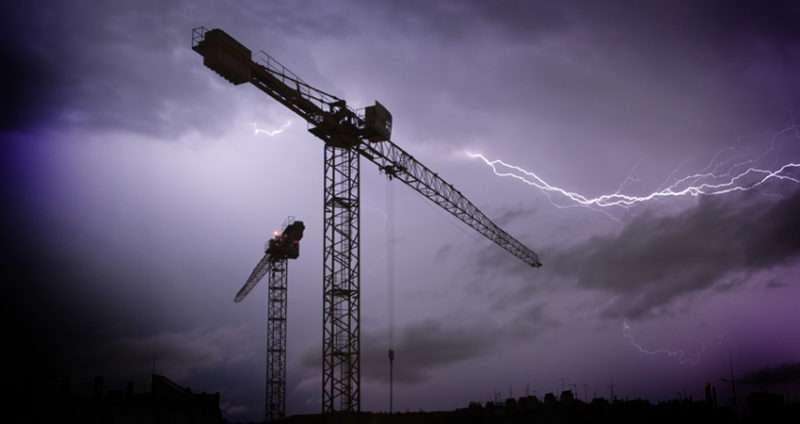
Tower cranes are one of the important machines frequently used in the construction industry. However, due to their height and metal density, they can pose serious risks due to lightning hazard. In such a case, it is very important to protect tower cranes from lightning due to the overturning of the crane, the burning of the sensor systems for internal consumption and the safety of the employees.
Lightning Impacts and Protection Stages in Tower Cranes
Lightning is a high voltage electrical discharge and is one of the deadliest natural disasters. A lightning strike can cause a potential difference of millions of volts per second and consequently generate a current in the order of 100 kA. Since tower cranes also have the potential to attract lightning, the consequences of an electrical pulse of this size will be severe. In this case, lightning protection of tower cranes is provided primarily by lightning rods, in other words, by using lightning rods, and secondarily by using a correct grounding system.
Primary Protection: In primary protection, lightning tips are placed on the top of tower cranes with arms coming out from the sides to protect against strikes from all directions and provide protection by transferring the attraction potential of the lightning to the ground with the rolling sphere method. The rolling sphere method is important for the protection design of the lightning discharge as it predicts how the lightning strike will behave on structures such as high voltage lines, buildings and tower cranes and which path it will follow, and helps to create a more effective protection design.
Secondary Protection: In the secondary protection, a grounding system is used in case of a very high dimensional lightning strike in case the crane overturns. Grounding systems are placed at the base of tower cranes and minimise the effects of lightning. At this point, the correct grounding criteria also increase the rate of operational safety. First of all, it should be ensured that the grounding transition resistance is as low as possible with a maximum of 10 ohms, and the conductor used should be of high quality and corrosion resistant in order to ensure fast pulse transfer. In addition, the earthing conductor must be of sufficient thickness and properly installed.
LV Surge Arrester Effect in Lightning Protection
Another equipment that plays an active role in lightning protection of tower cranes is LV surge arrester systems. Surge arresters used in tower cranes provide additional operational safety by protecting the crane body, sensitive sensor systems operating at low voltage and other electrical components from lightning. According to IEC 61643 standard for impulse protection devices connected to low voltage network systems, LV surge arresters that reach the lightning discharge current capacity determined at 10/350 μs should be preferred.
Detectors and Periodic Maintenance Also Play a Role in Protection
In addition to the mentioned protection schemes, lightning detectors also contribute indirectly to the protection of tower cranes. Lightning detectors measure the surrounding electric field with the detector antenna, thereby detecting an approaching lightning storm in advance and helping to activate other lightning protection measures such as surge arresters or earthing systems in a timely manner.
Periodic maintenance is also vital for the safe operation and long operational life of tower cranes. For this reason, it is especially important to periodically check earthing and carry out tests of protection equipment such as LV surge arresters. In addition, tower cranes should also be periodically checked in accordance with local legislation and standards.